

Few automotive emblems are as instantly recognizable as the Porsche logo. The golden shield with the prancing black horse, red-and-black stripes, and “Stuttgart” lettering has adorned the hoods of 911s, Cayennes, and Taycans for many decades. But what does the Porsche logo actually mean? Who designed it? Why did they choose a horse? And why did Porsche quietly redesign it in 2023?
This in-depth guide covers everything: the complete timeline from 1952 to today, the symbolism behind every element, the differences between the crest and the wordmark, and the subtle 2023 refresh that most people still haven’t noticed.
The Birth of the Icon: New York, 1952
Contrary to popular belief, the idea for the Porsche crest did not originate in Stuttgart. It emerged during discussions in New York City in late 1952, when Ferry Porsche met with his U.S. importer, Max Hoffman.
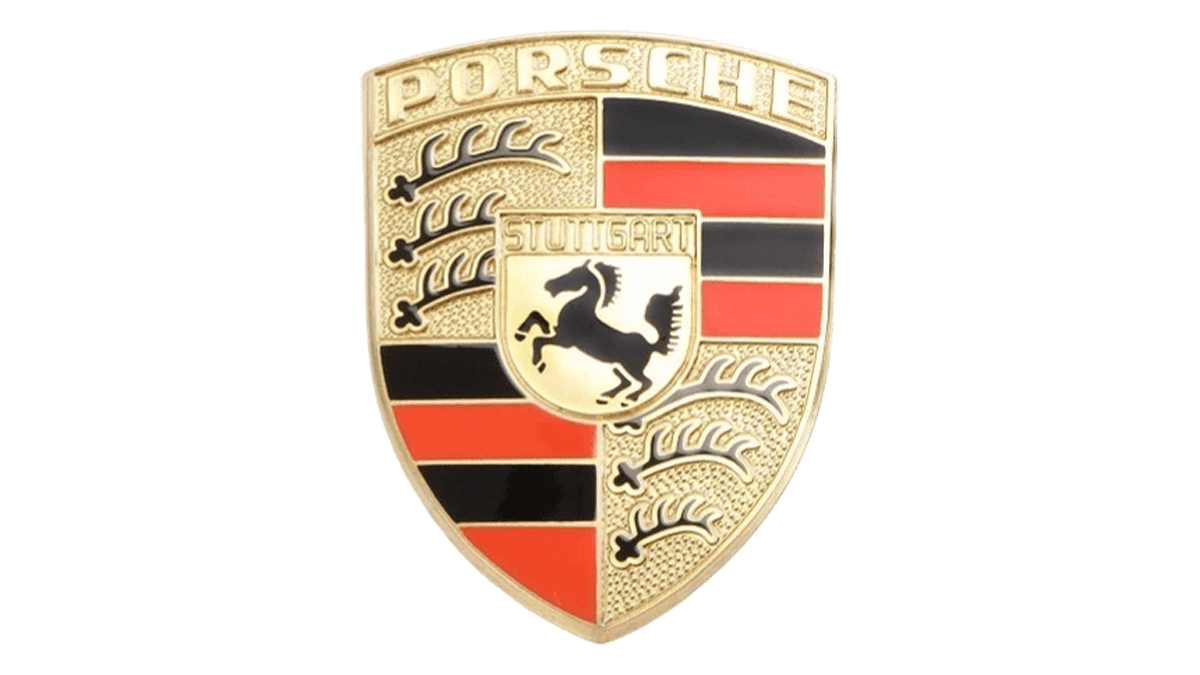
Porsche and Hoffman were discussing how to make Porsche stand out in the booming U.S. market. Hoffman suggested a proper hood crest, something prestigious like Ferrari’s prancing horse or Mercedes’ three-pointed star. Ferry sketched a concept on a napkin: a shield combining the coat of arms of the Free People’s State of Württemberg (red-black stripes and antlers) with Stuttgart’s traditional rearing horse. The word “Porsche” would sit proudly at the top.
The final design was refined back in Stuttgart by draftsman Franz Xaver Reimspiess, the same engineer who designed the Volkswagen Beetle’s torsion-bar suspension. The official trademark was registered on December 27, 1952, and first appeared on the steering wheel boss of the 356 in 1953. It moved to the hood in 1954.
Decoding Every Element of the Porsche Crest

| Element | Origin | Meaning / Symbolism |
| Prancing black horse | Coat of arms of the city of Stuttgart | Represents power, speed, elegance; references Stuttgart’s heritage as a horse-breeding center since 950 AD |
| Red-and-black stripes | Flag of the Free People’s State of Württemberg (1922–1945) | Regional pride; Württemberg-Hohenzollern was the state where Porsche is headquartered |
| Golden antlers | Part of the Württemberg coat of arms | Symbol of strength and nobility |
| Shield shape | Heraldic tradition | Prestige and protection |
| “Stuttgart” lettering | City name in stylized Fraktur-inspired font | Direct nod to the company’s home city |
| “Porsche” at the top | Family and company name | Brand identity |
Fun fact: The horse on the Porsche logo is not a direct copy of the Ferrari prancing horse. Ferrari’s horse came from Italian WWI flying ace Francesco Baracca and faces left. The Stuttgart horse has faced right since the 13th century.
Porsche Logo Evolution: 1952 – 2025 Timeline



| Year | Change | Visual Difference |
| 1952–1963 | Original hand-painted version — slightly rougher lines, deeper gold | Rich metallic gold, visible brush strokes |
| 1963 | Switch to printed decals for mass production | Cleaner lines, brighter gold |
| 1973 | Minor refinement for 911 Carrera RS — slightly larger horse | More aggressive stance |
| 1994 | Introduction of reflective metallic finish | Mirror-like gold background |
| 2008 | Subtle 3D effect and richer red tones for new Panamera launch | Deeper reds, raised elements |
| 2014 | Minor cleanup of antlers and lettering | Sharper edges |
| 2023 | Biggest update in 70 years — “brushed aluminum” look, honeycomb texture on horse | Modern, lighter appearance; first change since 2008 |
The 2023 Porsche Logo Refresh: What Actually Changed?
In June 2023, Porsche unveiled the sixth generation of its crest, the most significant update since 2008. The changes are subtle at first glance but deliberate:
- Gold background now has a brushed aluminum texture instead of polished gold
- The horse gains a subtle honeycomb pattern (nod to the Taycan’s electric era)
- Red stripes are slightly darker and more saturated
- Antlers simplified with fewer points
- “Porsche” lettering is bolder and more spaced
- Overall appearance is lighter and more contemporary
The updated crest first appeared on the 2024 Porsche 911 GT3 RS hood and is now rolling out across the entire lineup.


Porsche Wordmark vs. Crest: What’s the Difference?
Many people confuse the two logos:
- Porsche Crest (shield): Used on hoods, steering wheels, wheel caps, and official signage
- Porsche Wordmark (“Porsche” in script): Used on rear decklids, side scripts, and marketing

The wordmark itself has evolved too:
- 1952–1963: Tall, narrow lettering with long serifs
- 1963–2008: Shorter, bolder version
- 2008–present: Current modern script with slight slant
Why Authentic Porsche Crests Are Hard to Replicate Accurately
Porsche AG owns more than 300 trademark registrations for its crest worldwide. The company aggressively pursues counterfeiters —especially in Asia where fake Porsche badges are common on tuned VWs and Toyotas. In 2024 alone, German customs seized over 45,000 counterfeit Porsche emblems.
How to Spot a Real Porsche Crest (For Collectors)
| Feature | Genuine Porsche Crest | Fake / Aftermarket |
| Material / | Solid brass or aluminum with enamel inlay | Cheap pot metal or plastic |
| Weight | Surprisingly heavy (hood crest ≈ 180–220 g) | Very light |
| Backside | Porsche part number stamped (e.g., 992 853 075 A) | Blank or wrong numbering |
| Finish | Perfectly smooth, no bubbles in enamel | Visible imperfections, orange-peel texture |
| Pins | Precisely machined, perfectly straight | Bent or uneven |
The Porsche Logo in Pop Culture
- Featured in countless films (Bad Boys, Top Gun: Maverick, The Wolf of Wall Street)
- Kanye West wore a vintage Porsche crest necklace worth $35,000
- The crest appears on everything from $15,000 limited-edition Richard Mille watches to $10 keychains
Final Thoughts: Why the Porsche Logo Endure
In an era when many carmakers are abandoning badges for minimalist designs (looking at you, BMW and VW), Porsche has wisely kept its iconic crest while gently modernizing it. The combination of regional heritage, racing success, and timeless design makes it one of the most valuable automotive logos in the world, with an estimated brand value exceeding $35 billion in 2025.
Whether it’s gleaming on a 1955 356 Speedster or subtly updated on a 2025 Taycan Turbo GT, the Porsche logo remains a symbol of engineering excellence, Stuttgart pride, and the relentless pursuit of perfection.
Want to see every version side-by-side? Download our free high-resolution Porsche logo evolution pack (1952–2025) here.
