

The Mazda logo has long been a symbol of innovation, resilience, and forward-thinking design in the automotive world. As of December 2025, Mazda’s latest logo refresh, unveiled at the Japan Mobility Show in October, sparked renewed interest among car enthusiasts, designers, and brand historians. This sleek, digitally optimized version of the iconic winged “M” builds on nearly a century of evolution, blending heritage with modernity.
For those searching for “Mazda logo,” understanding its journey reveals not just a visual mark but a narrative of cultural fusion, technological ambition, and symbolic depth. From its humble beginnings as a cork manufacturer to its status as a global automaker, the Mazda logo embodies the brand’s “Zoom-Zoom” spirit of joyful driving and continuous improvement. In this comprehensive article, we’ll delve into the history of the Mazda logo, its meaning, key design elements, cultural impact, comparisons to other car brands, and what the 2025 update signifies for the future. Whether you’re looking for Mazda logo PNG downloads, vector files, or insights into its symbolism, this guide covers it all.
The Origins of the Mazda Name and Early Logos
The story of the Mazda logo begins in 1920, when the company was founded in Hiroshima, Japan, as Toyo Cork Kogyo Co., Ltd., a manufacturer of cork products amid post-World War I shortages. The name “Mazda” didn’t appear until 1931, when the company produced its first vehicle, the Mazda-Go three-wheeled truck. Derived from the surname of founder Jujiro Matsuda (pronounced “Mazda” in European languages), it also draws inspiration from Ahura Mazda, the Zoroastrian god of wisdom, intelligence, harmony, and light. This dual origin reflects a fusion of Eastern spirituality and Western cultural beginnings, symbolizing the brand’s aspiration to illuminate the automotive industry with innovation and positive impact.
Early Mazda logos were simple and functional, mirroring the company’s industrial roots.


From 1920 to 1928, the emblem was an abstract geometric design in thick black lines, resembling a shuriken (Japanese throwing star) within a circular shape that evoked power and precision.


By 1928-1931, it evolved into a minimalist red and white badge with a clean circle and two thick horizontal lines extending from the frame to the center, leaving a gap in the middle. This design emphasized simplicity, a hallmark of Japanese aesthetics.


In 1931-1933, collaboration with Mitsubishi influenced the logo: three rhombuses forming a triangle (echoing Mitsubishi’s three-diamond emblem) overlaid with a black cursive “Mazda” logotype. This partnership highlighted early sales distribution ties.
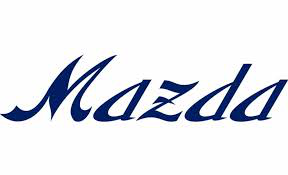

1934, the logo simplified to just the italicized wordmark in blue with thinner lines—coinciding with the launch of the first three-wheel truck.
These initial designs focused on legibility and brand recognition rather than deep symbolism, setting the stage for more evocative iterations as Mazda transitioned from machinery to automobiles


The 1936-1959 era introduced the first truly symbolic Mazda logo: three parallel lines forming three “M”s (standing for “Mazda Motor Manufacturer”), inspired by the flowing rivers of Hiroshima and evoking wings for agility, speed, and rapid development. Often called the “emblem of wings,” it symbolized the city’s resilience post-atomic bombing and Mazda’s ambition to soar.


This period also saw variants like the 1951-1972 geometric badge with three downward-pointing triangles in thin lines, adding an abstract, modern flair.
The Evolution of the Mazda Logo: A Timeline of Key Changes
Mazda’s logo evolution accelerated in the mid-20th century, aligning with the company’s shift to passenger cars and global expansion.


From 1954-1974, a blue and white uppercase “Mazda” in a narrowed italicized sans-serif typeface appeared, with bold lines and distinct edges emphasizing reliability and power.


This was followed by the 1959-1975 soft “m” in a round frame, designed to be eye-catching for models like the R360 coupe. It marked Mazda’s entry into passenger vehicles, reflecting values of approachable design.
The 1975-1991 logo was a pivotal shift: a futuristic, bold “Mazda” typeface without symbols, introduced as part of a corporate identity (CI) system.


This included the Mazda Blue color and a corporate symbol embodying enterprising spirit, high quality, and humanity.
Pioneering in Japan, it unified the brand’s image and remains influential today, with its custom sans-serif style (similar to Snasm Regular or Toxigenesis Bold) evoking innovation.


The 1990s brought symbolism back. The 1991-1992 emblem was a diamond-shaped design representing the sun, wings, and a halo—evoking Ahura Mazda’s light.


However, its resemblance to Renault’s diamond prompted a quick 1992-1997 revision: rounded edges for a friendlier, more circular form, adding connotations of loyalty and trustworthiness.


This laid the groundwork for the iconic 1997-2015 logo: V-shaped wings forming an “M” within an oval frame. Symbolizing flexible thinking, vitality, movement, and future-oriented progress, it included the 1970s blue nameplate, evoking flight and growth.
The “V” angle represented embracing challenges, aligning with Mazda’s rotary engine innovations and “Zoom-Zoom” philosophy.


From 2015 to 2018, the emblem featured a matte silver finish, with the logotype in silver and a thin blue outline, recalling early designs while signaling progress.


The 2018-2024 version refined this: lowercase letters except for a capital “D,” in silver gray for a modern, sophisticated look. It embraced a “dynamic wing” graphic in 2008 for global identity, tilting “Zoom-Zoom” lettering at an angle.


The most recent evolution came in 2024/2025: a flat, black, minimalistic design with solid lines, clean angles, and no gradients. Announced on October 29, 2025, via a press release, this update inherits the 1997 winged “M” spirit but refines it for digital visibility.
Making it sleeker and bolder for screens, apps, and global recognition. The wordmark is modernized, creating a “bridge to the future” amid Mazda’s electrification push. This flat design enhances strength and innovation, making it versatile for media like websites and EVs.
Throughout these changes, Mazda logos have balanced heritage and adaptation. For downloads, sites like 1000logos.net offer SVG and PNG versions of historical and current emblems, ideal for designers.
The Deep Symbolism and Design Elements of the Mazda Logo
At its core, the Mazda logo’s symbolism ties back to Ahura Mazda: harmony, wisdom, and light. Wings represent flight toward the future, creativity, vitality, kindness, resilience, and daring against odds. The “M” shape honors the founder’s name, while the oval or circle evokes unity and eternity. The “V” in the wings symbolizes overcoming challenges, mirroring Mazda’s history of innovation, like the Wankel rotary engine.
Design elements include Mazda Blue (a sophisticated hue for sophistication) and silver gradients (now flat black for minimalism). The custom sans-serif font is futuristic and neat, ensuring timeless elegance. These choices make the logo scalable for everything from car badges to digital ads, maintaining impact across backgrounds.
Cultural Impact and Comparisons to Other Car Logos
The Mazda logo’s cultural impact lies in its East-West fusion: Japanese precision meets Zoroastrian spirituality, symbolizing global harmony. It reflects Hiroshima’s resilience and Mazda’s role in post-war recovery, inspiring themes of growth in automotive culture. Compared to other brands, its wings echo Bentley’s flying “B” or Aston Martin’s wings but uniquely form an “M.” The 1991 diamond similarity to Renault led to quick changes, highlighting competitive design pressures. Unlike Toyota’s interlocking ovals (symbolizing trust) or Honda’s “H” (simplicity), Mazda’s emphasizes motion and aspiration, aligning with its premium positioning.
The 2025 Refresh and the Future of the Mazda Logo
The 2025 update, rolled out post-Japan Mobility Show, keeps the winged “M” but loses some “soul” for digital flatness based on what critics say. Yet it positions Mazda for EVs and tech integration. Future iterations may incorporate sustainability symbols, like greener hues, as the brand electrifies.
Hence, the Mazda logo is more than a mark; it’s a testament to evolution, meaning, and cultural depth. From cork origins to 2025’s digital wings, it inspires ongoing searches for “Mazda logo history” and beyond. For the latest PNG or vector, check official sources and Zoom-Zoom into Mazda’s enduring legacy.
